Tuesday, October 30, 2018

Following the Rules

David Gets in Trouble
Written and illustrated by: David Shannon
Published by: Blue Sky Press, 2002
32 Pages
Realistic Fiction

   David is a mischievous little boy who doesn't think anything is his fault. No matter what he does wrong, he has an excuse. He soon realizes that apologizing is the right thing to do, but he still has to face the consequences for his actions.

   David Shannon is an author-illustrator that bases his books on his past. The watercolor paintings are very childish, with thin and sloppy lines, representing things a child might draw and write. The text appears as a child's handwriting, as if David (the character) wrote it. 
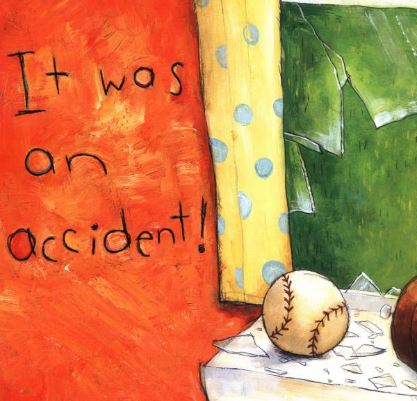

   I would use this book in a Kindergarten classroom. Upon reading, we would create a list of classroom rules, and I would explain to the students the importance of honesty and integrity. It is important for young children to understand that there are consequences to all actions, good and bad. This book represents a visual of what to do and what not to do when no one is looking. This book is also an excellent resource for ELL students because they can see what David does and what happens when he does bad things.

Wednesday, October 17, 2018

PLANTZILLA

Plantzilla
Written by: Jerdine Nolen
Illustrated by: David Catrow
Published by: HMH Books, 2005
32 Pages
Science Fiction


   Mortimer loves the class plant so much that he wants to take it home to care for over the summer. In a hilarious exchange of letters, Mortimer's decision is beginning to unfold as a mistake. With the mysterious disappearance of various foods, and even his mom's chihuahua, what will happen to the culprit? Will Plantzilla overstep his welcoming or be welcomed as a part of the family?
   Catrow is an award-winning cartoonist and writer of children's literature. His watercolor paintings in Plantzilla speak volumes about his work. The illustrations are humorous, enjoyable, and highlight intriguing details that readers cannot overlook. The letters on which the story is written can be tricky, especially for young or struggling readers due to the different fonts. In a younger classroom, this book would be best if read-aloud.


   This book would be an amusing way to introduce the following Science standard:

9 ) Examine evidence to support an argument that the internal and external structures of plants (e.g., thorns, leaves, stems, roots, colored petals, xylem, phloem) and animals (e.g., heart, stomach, lung, brain, skin) function to support survival, growth, behavior, and reproduction.

By introducing carnivorous plants, students can compare and contrast the parts of carnivorous and non-carnivorous plants and relate it to parts of an animal. Having a Venus Fly Trap and a regular plant, such as a sunflower, is a must in order to provide a visual of how the two plants "eat and drink".


Friends in Space

Earth to Clunk
Written by: Pam Smallcomb 
Illustrated by: Joe Berger
Published by: Dial Books, 2011
40 Pages
Science Fiction


   The main character found out he has a pen pal named Clunk from Planet Quazar. But he doesn't want a pen pal. So he sends him a letter, attached to his sister. That'll teach him to have a pen pal from Earth. Clunk sends back some interesting things, including a Zoid that follows him around. Does the boy warm up to his pen pal from Quazar?
   Berger uses vibrant illustrations that reflect what a species might look like from another planet. With images that appear to be from a cartoon, the reader can remain engaged (and humored) waiting for the next object from the foreign planet to arrive. 


   This book can be used in Science prior to introducing the Solar System to students. In higher grades, I would use it to talk about life on other planets and the lack of components necessary to support life. I also want to experiment with having a pen pal in another country or state, so this would be an intriguing way to explain what a "pen pal" is.

From Seed to Plant

How a Seed Grows
Written by: Helene J. Jordan
Illustrated by: Loretta Krupinski
Published by: HarperCollins, 2015
32 Pages
Nonfiction


   This picture book teaches children the process a seed goes through as it grows into a flower, tree, or plant. This nonfiction book is complete with pictures of the different kinds of seeds and the different things they grow into.
   Colored pencils were used to display beautiful, detailed, and realistic portrayals of the real-life things students see daily when they take a walk outside.


5 ) Plan and carry out an investigation, using one variable at a time (e.g., water, light, soil, air), to determine the growth needs of plants.

   Using the above science standard, I would put pictures with some facts on the corresponding flower or tree before class. I would read this book to second graders. Then, I would give different students different pictures of plants and seeds. We would take a nature walk, and students would match their pictures to the pictures on the plants outside. After all students have found their correct station, each group would take turns visiting other stations, learning new facts about each.

  I like this book because it is factual, but it doesn't feel like a textbook. Realistic pictures can often feel boring to students, while illustrations and paintings feel like another fun story.

Ocean Creatures

The Big Book of the Blue
Written and Illustrated by: Yuval Zommer
Published by: Thames & Hudson, 2018
64 Pages
Nonfiction


   This colorful picture book is filled with the different animals that live in the ocean, complete with interesting facts about the components that help underwater creatures survive underwater.
   The illustrations in this book are vibrant paintings. Although they are unrealistic, the paintings do portray the different features of the different animals in a way that helps the young reader notice them.
   Since this book is 64 pages long, it wouldn't be ideal to read the entire book in one setting. However, it would be a great tool to reference when talking about the individual animals and facts about each. 

Grade level: 2nd
Science Standard: 7 ) Obtain information from literature and other media to illustrate that there are many different kinds of living things and that they exist in different places on land and in water (e.g., woodland, tundra, desert, rainforest, ocean, river).
   

From a Goldfish's Point of View

Memoirs of a Goldfish
Written by: Devin Scillian
Illustrated by: Tim Bowers
Published by: Sleeping Bear Press, 2010
32 Pages
Modern Fantasy

   It's an easy life swimming around a fish bowl all day..... until new decorations and pets begin to overcrowd. This story is told from the point of view from a goldfish and explains how each day gets a little harder.
   Bowers uses vibrant illustrations that help young readers see the different objects overcrowding the fishbowl. Although this is not a wordless picture book, the images could alone tell the story. As seen on the cover, the goldfish has a helpless expression on his face, which is seen mostly throughout the entire book. 
   In a fourth grade language arts classroom, students must be able to identify the different points of view. I would choose this story along with a story told in second and third person to align with the following Language Arts standard:

6 ) Compare and contrast the point of view from which different stories are narrated, including the difference between first- and third-person narrations. [RL.4.6]

   I like how each page has the heading of the day in a different color.This helps readers automatically identify that it is the beginning of a new day, and they are already looking at the illustrations trying to find out what new object is in the fish bowl.